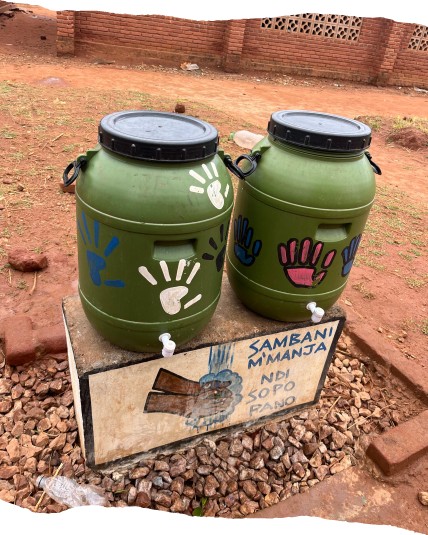
Our New Year began with a co-planning meeting at the primary school in Mchinji where we have been implementing our hand hygiene Trial of Improved Practices (TIPs). An issue highlighted during the TIPs was refilling the water containers in the handwashing stations-these structures have no direct water source and have to be filled by the learners with water drawn from the borehole.
De-centralised handwashing facility-these have been implemented as part of the TIPS with handwashing reminders painted on the base.
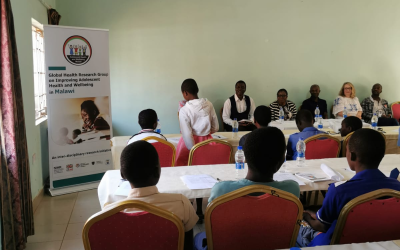
Our meeting brought together peer educators (selected adolescents for different classes) and teachers. Yes, children and adults co-planning in one room! We were cautious in our approach, especially as listening to the views of young people is not common in rural Malawi, but we needn’t have worried, as one thing soon became clear: adolescents have a voice, and adults need to listen to them and take their opinions seriously.
We began the meeting with introductions and a clear explanation of its purpose. A key emphasis was creating a safe space for adolescents to express their views. They were encouraged to feel free to share anything and not to be intimidated by the presence of teachers. We asked them to see teachers as friends and partners in the discussion. At the same time, teachers were encouraged to listen attentively to adolescents’ voices and to genuinely consider their ideas.
The co-planning meeting focused on the water refilling approach for handwashing facilities. Findings from the TIPs endline data revealed challenges related to the practicality of the refilling approach that the school had selected and implemented. However, for a successful handwashing intervention, it was critical to understand what approach would work in practice.
The meeting therefore provided a platform to hear directly from those responsible for water refilling at the school. Learners were given the opportunity to suggest improvements they felt would be realistic and sustainable. Previously, the school had implemented a class-by-class duty roster for refilling water at handwashing facilities near the toilets, classrooms, and where learners buy snacks with the school. Despite this, inconsistent refilling was observed, and water for handwashing was not always available.
One important question was posed: “Why are we still experiencing inconsistent refilling when we already have an approach that we put in place ourselves, and what can be done differently?” They had chosen a class by class a day duty roster water refilling approach.
The room fell silent, but only briefly. What followed was a lively discussion, with learners being the first to speak up. By the end of the meeting, both learners and teachers agreed to continue with the existing approach, but with several key improvements, most of which were suggested by the learners themselves. They asked teachers to remind them of their duties and suggested that hard copies of the duty rosters be printed and displayed in each classroom. When teachers raised concerns about water refilling containers being left scattered around the school premises affecting the school’s appearance, learners quickly proposed a solution: they would store the containers in a room that was not in use. Teachers also agreed to take turns in supervising the learner to ensure water refilling is consistent.
As the days go by, everyone is eager to see whether these agreed-upon improvements will result in more consistent refilling. One thing, however, is already clear: adolescents do have a voice. When given space, they can express themselves thoughtfully and responsibly. They simply need adults who are willing to listen.