International Adolescent Health Week 2026: 10 Voices for 10 Years

The Day of the African Child 2026: Ensuring universal access to water, sanitation, and hygiene for every child in Africa

As Africa marks the Day of the African Child 2026, attention turns to the urgent need for universal access to water, sanitation, and hygiene (WASH) for every child. Through the NIHR Global Health Research Group on Improving Adolescent Health and Wellbeing in Malawi, researchers are working with adolescents, schools, and communities in Blantyre and Mchinji to co-design practical solutions that promote health, dignity, and educational participation. Discover how collaborative research is helping to improve WASH outcomes and ensure that no child is left behind.

Building a #PeriodFriendlyWorld: What the Adolescent Health and Wellbeing Study in Malawi Reveals About Menstrual Hygiene in Schools

As the world commemorates Menstrual Hygiene Day 2026, our study serves as a reminder that many girls are still managing menstruation under difficult conditions. A #PeriodFriendlyWorld can only become reality when every girl has access to safe spaces, clean water, menstrual products, accurate information and supportive communities. No girl should miss school, feel ashamed, or struggle to manage her period with dignity. On this Menstrual Hygiene Day, let us move beyond awareness and commit to meaningful action that supports adolescent girls’ health, education, and wellbeing. Together, we can create schools and communities where menstruation is no longer a barrier to opportunity and dignity.

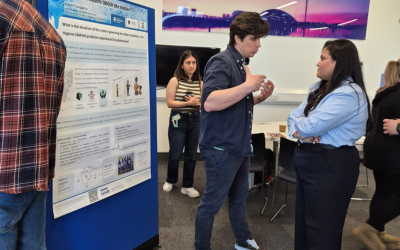
Where Water Flows, Insights Grow: A Week in Glasgow

A week in Glasgow offered fresh insights and powerful reminders of why WASH matters for adolescents’ health and wellbeing. From World Water Day discussions to exchanges with researchers and practitioners, the visit strengthened our commitment to co‑creating practical WASH solutions with young people in Malawi. It was a week filled with learning, connection, and renewed purpose.

More Than Just Doors: Creating Safer and More Dignified School Toilets

As part of the ongoing learning and adaptation process, the research team introduced an additional improvement at Chimwankhunda Primary School: the installation of doors on the school toilets. This enhancement followed feedback from key stakeholders particularly school management and learners who raised concerns about unrestricted community access to the school sanitation facilities. Such access was found to affect both the effective implementation and the long-term sustainability of the TIPs activities. Importantly, learners also highlighted the need for improved privacy while using the toilets.

Our Women Early Career Researchers Reflect on Their Journey in Global Health

In the spirit of this year’s International Women’s Day themes; from “Rights. Justice. Action. For ALL Women and Girls” to the call to “Give to Gain” – their journeys remind us that progress is built through collaboration, mentorship, and the sharing of knowledge and opportunities. By investing in women researchers today, we help strengthen the evidence, leadership, and partnerships needed to improve the health and wellbeing of adolescents and communities tomorrow. With that, we thank all the phenomenal women Early Career Researchers across the project for sharing their experiences and for the important contributions they continue to make to global health research.

World Day of Social Justice 2026

On World Day of Social Justice, we’re reminded that too many adolescents still face futures shaped by inequality.
At NIHR-GHRG on Adolescent Health & Wellbeing in Malawi, we’re working to change this by elevating young people’s voices and examining how policies impact their lives.
Our research tackles gaps in education, health, protection, and representation, ensuring no adolescent is left behind.
Learn how we’re advancing fairer, more inclusive systems for young people worldwide.

Adolescents have a voice if we create a space to listen to them – co-planning a water refilling approach with adolescents and teachers

When a group of learners and teachers came together at a primary school in Mchinji, something powerful happened: young people were given the space to speak and adults truly listened. In this co‑planning meeting, adolescents shared practical ideas to improve how water is refilled at school handwashing stations, offering thoughtful solutions that surprised everyone. Their voices shaped the way forward, showing just how much can change when young people are invited into the conversation and given agency.

World Toilet Day

This World Toilet Day, we’re tackling one of the most overlooked challenges in education: safe, clean, and welcoming toilets for learners. Through the NIHR-GHRG initiative in Malawi, schools are co-creating practical solutions, from vibrant murals and sanitation-themed games to improved facilities and hygiene messaging. These changes go beyond cleanliness, they foster dignity, comfort, and wellbeing, ensuring every learner feels respected and supported.
Join us in making sanitation a priority. Share this message, support local initiatives, and help create environments where every child can learn with dignity. Together, we can turn neglected spaces into places of care and pride.

Our future is at hand, let’s move forward together – learning from what works

As the world observes Global Handwashing Day, the NIHR Global Health Research Group highlights ongoing efforts in Malawi to improve handwashing with soap among adolescents—where less than 1% of observed handwashing opportunities currently include soap use. Using the COM-B behaviour change approach, researchers are co-developing a participatory hand hygiene intervention with students and teachers in rural Mchinji to make handwashing easier, more appealing, and consistent. Through hands-on experiments testing soap types, dispensing methods, and behavioural nudges, the study revealed key preferences and practical challenges. These insights are now guiding a Trial of Improved Practices (TIPs) to create a sustainable, evidence-based solution that empowers young people to make handwashing with soap a lasting habit, truly putting “our future is at hand.”

Celebrating Mental Wellbeing in Young People Using Creative Storytelling in Blantyre, Malawi

As the world marked World Mental Health Day on 10th October, the NIHR Global Health Research Group’s ‘Inspiring Adolescent Wellbeing’ Work Strand in Blantyre, Malawi, celebrated the power of creative storytelling in nurturing young people’s joy, resilience, and belonging. Using the Scottish Storyline methodology, children expressed their emotions and ideas through drawings, drama, and poems – creating safe, inclusive spaces where their voices were heard and valued. The workshops reminded us that mental wellbeing flourishes not only through addressing challenges but also by celebrating creativity, play, and the joy of connection.

October 9, 2026

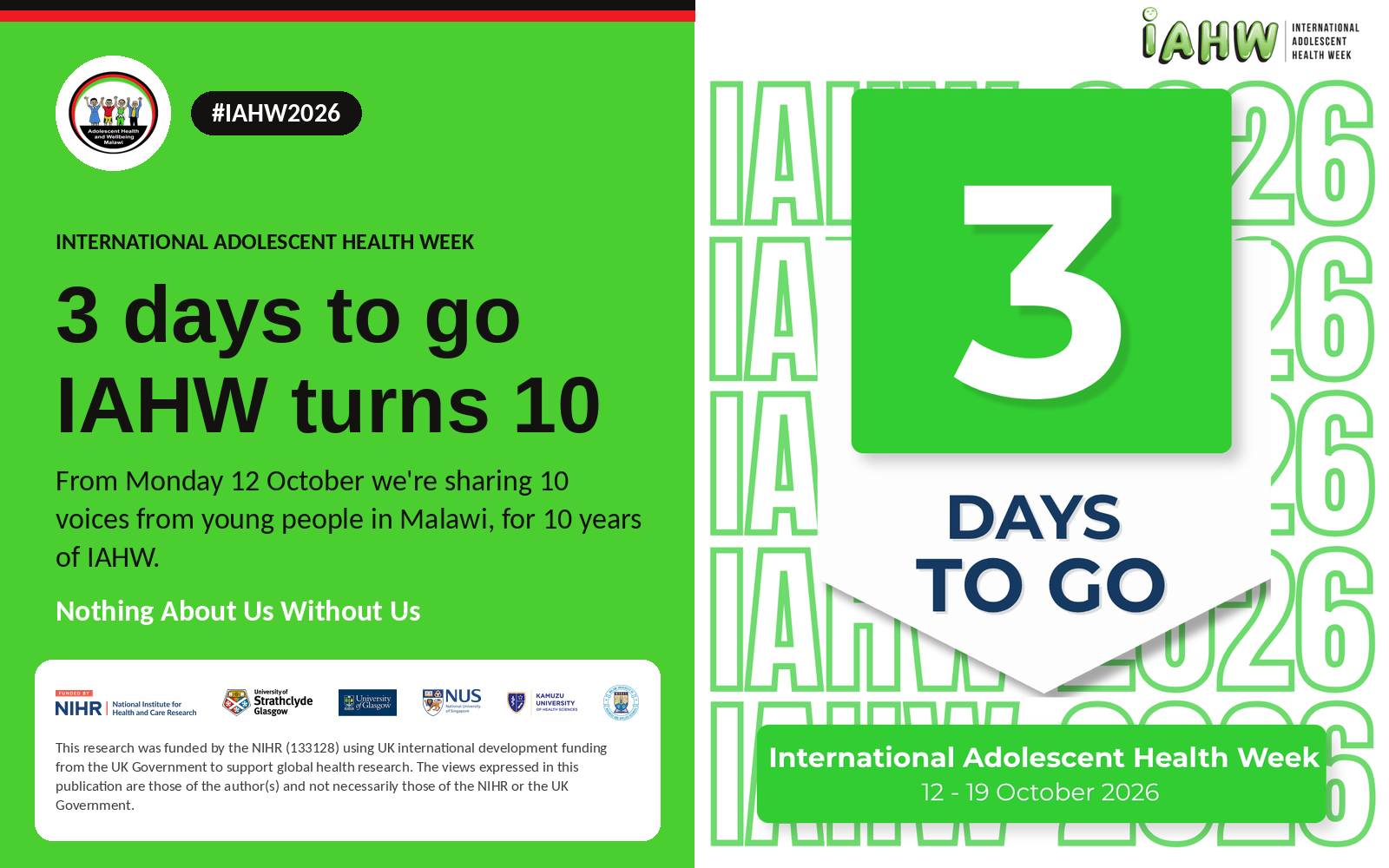
International Adolescent Health Week starts on Monday!

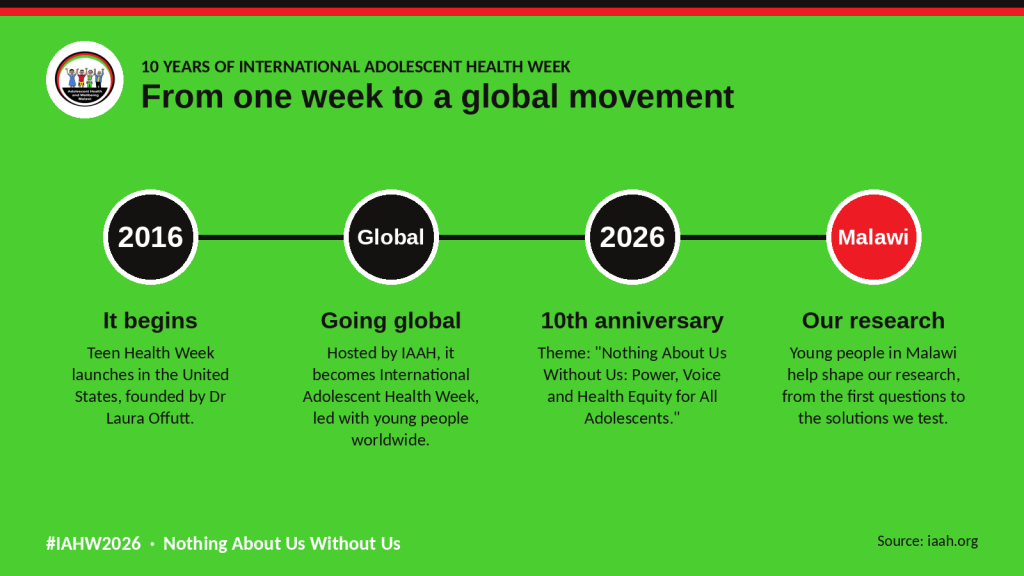
International Adolescent Health Week (IAHW) runs from 12 to 18 October and this year celebrates its 10th anniversary. The theme, “Nothing About Us Without Us: Power, Voice and Health Equity for All Adolescents”, reflects how we work: young people in Malawi help shape our research at every stage.

About IAHW and IAAH

International Adolescent Health Week began in the United States in 2016 as Teen Health Week. It was founded by Dr Laura Offutt, a member of the International Association for Adolescent Health (IAAH), and has grown into a global, grassroots week that brings together young people, health workers, teachers, parents and communities. Today it is hosted by IAAH, whose mission is to strengthen skills, national capacity and global investment in adolescent health, using an approach grounded in equity and young people’s rights. Together, they aim to improve the lives of the more than 1 billion adolescents around the world.
Why it matters to us

These values sit at the heart of our NIHR Global Health Research Group on Improving Adolescent Health and Wellbeing in Malawi. Led by the University of Strathclyde with Kamuzu University of Health Sciences, the Malawi University of Business and Applied Sciences, the National University of Singapore and the University of Glasgow, our research works with young people rather than simply about them. From early conversations about the issues that matter to them, to co-designing and testing new approaches, and training peer educators to work alongside adults, adolescents in Malawi have helped shape our work at every stage. That is why this year’s theme, “Nothing About Us Without Us”, feels so close to home.

From Monday, follow us on Facebook, Instagram and LinkedIn as we share 10 voices from young people for 10 years of IAHW. #IAHW2026

Sources:
More from us ….

Where Water Flows, Insights Grow: A Week in Glasgow

I seized the chance for a week-long trip to Glasgow, dedicated entirely to Water, Sanitation, and Hygiene (WASH). I think it’s fair to say I made the most of it. I left with heaps of inspiration, insights, and meaningful connections, gained during numerous events at...